|
|

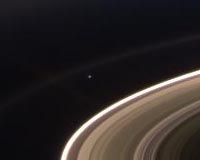
 Moffett Field CA (SPX) Aug 20, 2009 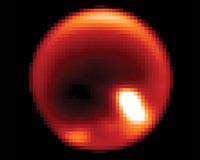 While far from a tropical rain forest, the equatorial region of Saturn's largest moon, Titan, has recently displayed tantalizing evidence that the parched, dry desert can support large-scale storms. The research, published in the journal Nature, announces the discovery of significant cloud formation (about three million square kilometers) within the moon's tropical zone near its equator. ... read more
  White Sands NM (SPX) Aug 20, 2009
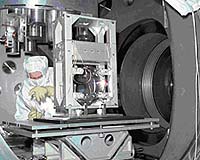
Anyone who's vacationed in the mountains or lived on a farm knows that it's hard to get good internet access or a strong cell phone signal in a remote area. Communicating across great distances has always been a challenge. So when NASA engineers designed the Lunar Reconnaissance Orbiter (LRO), they knew it would need an extraordinary communications system. Over the next year, the LRO, NASA ... more
|

| |||||||||||||||
| Previous Issues | Aug 19 | Aug 18 | Aug 17 | Aug 16 | Aug 13 |
| . |
 Sydney, Australia (SPX) Aug 20, 2009
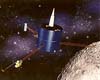
For decades, microsatellites have been a boon to spaceflight. A small satellite can be built and launched fairly cheaply, sometimes hitching a ride for free aboard a large satellite launch. So far, microsatellites have not ventured very far into space. Could one go all the way to the Moon? Amateur groups have speculated on this possibility for years, but none have actually built a bird and ... more  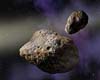 Pasadena CA (JPL) Aug 20, 2009
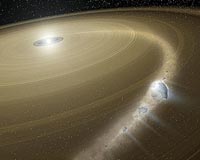
How our solar system was formed has fascinated scientists and laymen alike for - well, for a really, really long time. New research may have answered a piece to the puzzle - how big were the first planetesimals? For those of you scoring at home," planetesimals" were the first solid objects in our newly minted solar system (also known as the protoplanetary disk). They began life as small ... more  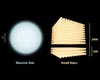 Pasadena CA (JPL) Aug 20, 2009
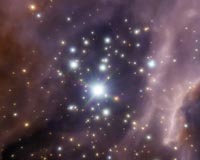
For decades, astronomers have gone about their business of studying the cosmos with the assumption that stars of certain sizes form in certain quantities. Like grocery stores selling melons alone, and blueberries in bags of dozens or more, the universe was thought to create stars in specific bundles. In other words, the proportion of small to big stars was thought to be fixed. For every st ... more |
. |
|
|
. |
 Sydney, Australia (SPX) Aug 17, 2009
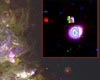
A team of scientists in Australia and the United States, led by Associate Professor Miroslav Filipovic from the University of Western Sydney, have discovered a new class of object which they call "Super Planetary Nebulae." They report their work in the journal Monthly Notices of the Royal Astronomical Society. Planetary nebulae are shells of gas and dust expelled by stars near the end of ... more   Washington DC (SPX) Aug 18, 2009
Will the universe expand outward for all of eternity and end in a vast, dark, cold, sterile, diffuse nothingness? Or will the "Big Bang" - the gargantuan explosion that formed the universe 14 billion years ago - end in the "Big Crunch?" Planets, stars and galaxies all hurtle inward and collapse into an incredibly hot, dense mass a billion times smaller than the period at the end of this ... more  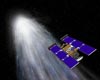 Greenbelt MD (SPX) Aug 18, 2009
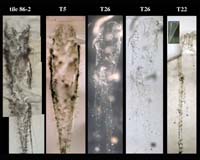
NASA scientists have discovered glycine, a fundamental building block of life, in samples of comet Wild 2 returned by NASA's Stardust spacecraft. "Glycine is an amino acid used by living organisms to make proteins, and this is the first time an amino acid has been found in a comet," said Dr. Jamie Elsila of NASA's Goddard Space Flight Center in Greenbelt, Md. "Our discovery supports the ... more |
. |
| Previous Issues | Aug 19 | Aug 18 | Aug 17 | Aug 16 | Aug 13 |
| The contents herein, unless otherwise known to be public domain, are Copyright 1995-2009 - SpaceDaily. AFP and UPI Wire Stories are copyright Agence France-Presse and United Press International. ESA Portal Reports are copyright European Space Agency. All NASA sourced material is public domain. Additional copyrights may apply in whole or part to other bona fide parties. Advertising does not imply endorsement, agreement or approval of any opinions, statements or information provided by SpaceDaily on any web page published or hosted by SpaceDaily. Privacy statement |