| June 25, 2009 |  |
a timely reality check |

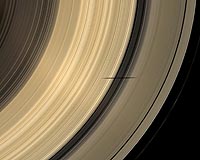
 Potsdam, Germany (SPX) Jun 25, 2009 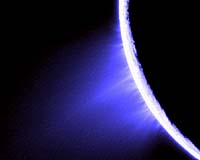 An enormous plume of water spurts in giant jets from the south pole of Saturn's moon Enceladus. In a report published in the international science journal Nature, European researchers provide evidence that this magnificent plume is fed by a salty ocean. The discovery could have implications for the search for extraterrestrial life as well as our understanding of how planetary moons are for ... read more
 Boulder CO (SPX) Jun 25, 2009
Water vapor jets that spew from the surface of Saturn's icy moon Enceladus are not really geysers from an underground ocean as initially envisioned by planetary scientists, according to a study led by the University of Colorado at Boulder. First observed following a close flyby by NASA's Cassini spacecraft in July 2005, the jets were found to consist of both water vapor and icy particles ... more
|

| |||||||||||||||
| Previous Issues | Jun 24 | Jun 22 | Jun 21 | Jun 19 | Jun 18 |
  Boston MA (SPX) Jun 25, 2009
The "coming of age" of galaxies and black holes has been pinpointed, thanks to new data from NASA's Chandra X-ray Observatory and other telescopes. This discovery helps resolve the true nature of gigantic blobs of gas observed around very young galaxies. About a decade ago, astronomers discovered immense reservoirs of hydrogen gas - which they named "blobs" - while conducting surveys of ... more   Moffett Field CA (SPX) Jun 25, 2009
The Lunar Crater Observation and Sensing Satellite, or LCROSS, successfully completed its most significant early mission milestone Tuesday with a lunar swingby and calibration of its science instruments. The satellite will search for water ice in a permanently shadowed crater at the moon's south pole. With the assist of the moon's gravity, LCROSS and its attached Centaur booster rocket ... more  Pasadena, Calif. (UPI) Jun 24, 2009
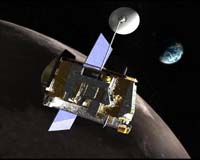
 The U.S. space agency's Diviner, an instrument that will map the moon's temperature, has entered a lunar orbit aboard NASA's Lunar Reconnaissance Orbiter. The instrument, a nine-channel radiometer built and managed by NASA's Jet Propulsion Laboratory, will also, for the first time, produce a map showing the composition of the moon, as well as a map showing how rocky the moon is. ... more  Greenbelt, Md. (UPI) Jun 24, 2009
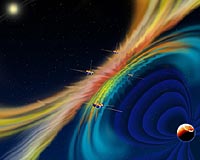
 The U.S. space agency says its Interstellar Boundary Explorer has made the first detection of very fast neutral atoms emanating from the moon. The discovery came during the spacecraft's commissioning, when scientists turned on the IBEX-Hi instrument, which measures atoms with speeds from about half a million to 2.5 million miles per hour. "Just after we got IBEX-Hi turned on, the ... more |
. |
      |
. |



 |
. |
  Bonn, Germany (SPX) Jun 23, 2009
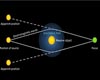
Ninety years ago, Arthur Eddington undertook an expedition to West Africa to confirm Albert Einstein's general theory of relativity. Eddington was not, of course, an ethnologist or geologist but an astrophysicist and he observed the solar eclipse there on 29 May 1919. This enabled him to photograph stars in the region around the Sun - stars which would otherwise have been obscured by the ... more   Boulder CO (SPX) Jun 22, 2009
In a breakthrough that will help scientists unlock mysteries of the Sun and its impacts on Earth, an international team of scientists led by the National Center for Atmospheric Research (NCAR) has created the first-ever comprehensive computer model of sunspots. The resulting visuals capture both scientific detail and remarkable beauty. The high-resolution simulations of sunspot pairs open ... more  Washington DC (SPX) Jun 23, 2009
Two NASA spacecraft will reach major mission milestones early Tuesday morning as they approach the moon - one will send back live streaming imagery via the Internet as it swings by the moon, the other will insert itself into lunar orbit to begin mapping the moon's surface. After a four and a half day journey to the moon, NASA's Lunar Reconnaissance Orbiter, or LRO, will be captured by the ... more   Paris, France (SPX) Jun 22, 2009
The next generation of instruments for ground-based telescopes took a leap forward with the development of a new ultra-fast camera that can take 1500 finely exposed images per second even when observing extremely faint objects. The first 240x240 pixel images with the world's fastest high precision faint light camera were obtained through a collaborative effort between ESO and three French ... more |
. |
      |
. |
   NASA launches Roman telescope on cosmic mapping mission
 DAMPE space telescope finds universal spectral feature that narrows field on cosmic ray origins
 Oxford Physicists Reach Fourth-Order Quantum Squeezing With Trapped Ion
 |
. |
|
| Previous Issues | Jun 24 | Jun 22 | Jun 21 | Jun 19 | Jun 18 |
| The contents herein, unless otherwise known to be public domain, are Copyright 1995-2009 - SpaceDaily. AFP and UPI Wire Stories are copyright Agence France-Presse and United Press International. ESA Portal Reports are copyright European Space Agency. All NASA sourced material is public domain. Additional copyrights may apply in whole or part to other bona fide parties. Advertising does not imply endorsement, agreement or approval of any opinions, statements or information provided by SpaceDaily on any web page published or hosted by SpaceDaily. Privacy statement |