| June 19, 2009 |  |
a timely reality check |

 Washington DC (SPX) Jun 19, 2009 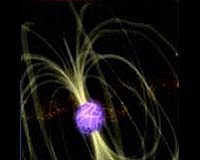 On Aug. 22, 2008, NASA's Swift satellite reported multiple blasts of radiation from a rare object known as a soft gamma repeater, or SGR. Now, astronomers report an in-depth study of these eruptions using the European Space Agency's XMM-Newton and International Gamma-Ray Astrophysics Laboratory (INTEGRAL) satellites. The object, designated SGR 0501+4516, was the first of its type ... read more
  Chicago IL (SPX) Jun 19, 2009
The interstellar stuff that became incorporated into the planets and life on Earth has younger cosmic roots than theories predict, according to the University of Chicago postdoctoral scholar Philipp Heck and his international team of colleagues. Heck and his colleagues examined 22 interstellar grains from the Murchison meteorite for their analysis. Dying sun-like stars flung the Murchison ... more
|

| |||||||||||||||
| Previous Issues | Jun 18 | Jun 17 | Jun 16 | Jun 15 | Jun 12 |
  Pasadena CA (SPX) Jun 19, 2009
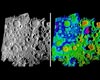
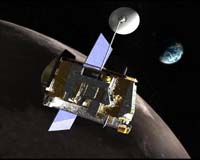
A new lunar topography map with the highest resolution of the moon's rugged south polar region provides new information on some of our natural satellite's darkest inhabitants - permanently shadowed craters. The map was created by scientists at NASA's Jet Propulsion Laboratory, Pasadena, Calif., who collected the data using the Deep Space Network's Goldstone Solar System Radar located in ... more  Tempe AZ (SPX) Jun 19, 2009
The Interdisciplinary A building on the Tempe campus looks rather average from the outside. There isn't anything that hints at the excitement, talent and innovation hidden behind its nondescript doors, and there is certainly no indication that the first steps of a great journey are taking place inside. For nearly two years, professor Mark Robinson and his team have called this building ... more  San Antonio TX (SPX) Jun 19, 2009
NASA's Interstellar Boundary Explorer (IBEX) spacecraft has made the first observations of very fast hydrogen atoms coming from the Moon, following decades of speculation and searching for their existence. During spacecraft commissioning, the IBEX team turned on the IBEX-Hi instrument, built primarily by Southwest Research Institute (SwRI) and the Los Alamos National Laboratory, which ... more 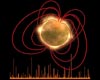 Paris, France (ESA) Jun 18, 2009
An enormous eruption has found its way to Earth after travelling for many thousands of years across space. Studying this blast with ESA's XMM-Newton and Integral space observatories, astronomers have discovered a dead star belonging to a rare group: the magnetars. X-Rays from the giant outburst arrived on Earth on 22 August 2008, and triggered an automatic sensor on the NASA-led ... more |
. |
      |
. |



 |
. |
 Bonn, Germany (SPX) Jun 17, 2009
"Of course," we might answer, "what a question!" However, we should also consider that our Sun - like all other stars - is a ball of hot gas. This gas ball, with a diameter of 1.4 million kilometres, is held together by gravity alone. This means that the Sun does not have a firm surface. Nevertheless, the Sun appears to us as a shining sphere with a sharp edge. The reason for this is that ... more  Chicago IL (SPX) Jun 17, 2009
The interstellar stuff that became incorporated into the planets and life on Earth has younger cosmic roots than theories predict, according to the University of Chicago postdoctoral scholar Philipp Heck and his international team of colleagues. Heck and his colleagues examined 22 interstellar grains from the Murchison meteorite for their analysis. Dying sun-like stars flung the Murchison ... more   London, UK (SPX) Jun 16, 2009
A novel bacterium that has been trapped more than three kilometres under glacial ice in Greenland for over 120 000 years, may hold clues as to what life forms might exist on other planets. Dr Jennifer Loveland-Curtze and a team of scientists from Pennsylvania State University report finding the novel microbe, which they have called Herminiimonas glaciei, in the current issue of the ... more   Pasadena CA (SPX) Jun 15, 2009
The most exotic frozen cocktails on Earth won't be found in a chic restaurant or trendy bar. Scientists are mixing up these icy concoctions in a rather nondescript laboratory not much bigger than a janitor's closet. The surroundings are spartan, but the recipes they're using are out of this world. Researchers in JPL's Ice Physical Properties Laboratory are recreating the ices found on the ... more |
. |
      |
. |
   NASA launches Roman telescope on cosmic mapping mission
 DAMPE space telescope finds universal spectral feature that narrows field on cosmic ray origins
 Oxford Physicists Reach Fourth-Order Quantum Squeezing With Trapped Ion
 |
. |
|
| Previous Issues | Jun 18 | Jun 17 | Jun 16 | Jun 15 | Jun 12 |
| The contents herein, unless otherwise known to be public domain, are Copyright 1995-2009 - SpaceDaily. AFP and UPI Wire Stories are copyright Agence France-Presse and United Press International. ESA Portal Reports are copyright European Space Agency. All NASA sourced material is public domain. Additional copyrights may apply in whole or part to other bona fide parties. Advertising does not imply endorsement, agreement or approval of any opinions, statements or information provided by SpaceDaily on any web page published or hosted by SpaceDaily. Privacy statement |