| June 16, 2009 |  |
a timely reality check |

 London, UK (SPX) Jun 16, 2009 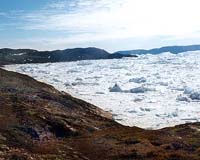 A novel bacterium that has been trapped more than three kilometres under glacial ice in Greenland for over 120 000 years, may hold clues as to what life forms might exist on other planets. Dr Jennifer Loveland-Curtze and a team of scientists from Pennsylvania State University report finding the novel microbe, which they have called Herminiimonas glaciei, in the current issue of the ... read more
  Pasadena CA (SPX) Jun 15, 2009
The most exotic frozen cocktails on Earth won't be found in a chic restaurant or trendy bar. Scientists are mixing up these icy concoctions in a rather nondescript laboratory not much bigger than a janitor's closet. The surroundings are spartan, but the recipes they're using are out of this world. Researchers in JPL's Ice Physical Properties Laboratory are recreating the ices found on the ... more
|

| |||||||||||||||
| Previous Issues | Jun 15 | Jun 12 | Jun 11 | Jun 10 |
 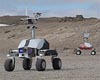 Moffett Field CA (SPX) Jun 15, 2009
NASA robots soon will begin exploring the dusty, rocky terrain of a barren desert on Earth much like the moon. Scientists and engineers will study the images and information the robots gather to help plan where humans should venture next. To simulate robots scouting on the lunar surface before a human space crew arrives, the "K10 Red" and "K10 Black" robots developed at NASA Ames Research ... more   Pasadena CA (SPX) Jun 15, 2009
Angelle Tanner, a post-doctoral scholar at JPL and Caltech, studies planets in distant solar systems, called extrasolar planets. The golden prize in this field is to find a planet similar to Earth - the only planet we know that harbors life. While more than 350 extrasolar planets have been detected, most are gas planets, with no solid surface. Many are located in orbits closer to their ... more  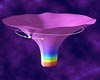 Bloomington IN (SPX) Jun 15, 2009
Black holes are a common topic for scientific discussion today - but to the astrophysicists, theoretical physicists and mathematicians attending Indiana University's Capra Conference on radiation reaction, predictions still outweigh proof when it comes to black holes and their interstellar antics. Hosted by IU for the first time in the event's 12-year history, the Capra Conference each ... more 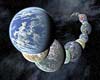 Manhattan KS (SPX) Jun 15, 2009
How did we get here and where are we headed? These are some of life's biggest questions. To get the answers, one Kansas State University professor is doing the math. Louis Crane, K-State professor of mathematics, is studying new theories about why the universe is the way it is. He has a grant from the Foundational Questions Institute to study new approaches to the quantum theory of gravity ... more |
. |
      |
. |



 |
. |
 Pasadena CA (SPX) Jun 12, 2009
In images made possible only as Saturn nears equinox, NASA's Cassini spacecraft has uncovered for the first time towering vertical structures in the planet's otherwise flat rings that are attributable to the gravitational effects of a small nearby moon. The new findings are presented in a paper authored by Cassini imaging scientists and published online in the Astronomical Journal. ... more  Boston MA (SPX) Jun 12, 2009
A new image from NASA's Chandra X-ray Observatory shows a supernova remnant with a different look. This object, known as SNR 0104-72.3 (SNR 0104 for short), is in the Small Magellanic Cloud, a small neighboring galaxy to the Milky Way. Astronomers think that SNR 0104 is the remains of a so-called Type Ia supernova caused by the thermonuclear explosion of a white dwarf. In this composite ... more 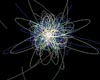 Pasadena CA (SPX) Jun 12, 2009
Astronomers have found that stars of a recently discovered type, dubbed ultracool subdwarfs, take some pretty wild rides as they orbit around the Milky Way, following paths that are very different from those of typical stars. One of them may actually be a visitor that originated in another galaxy. Adam Burgasser and John Bochanski of MIT presented the findings at the American Astronomical ... more  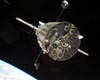 Paris, France (ESA) Jun 12, 2009
The fifth and final servicing mission for the Hubble Space Telescope may be over but for the ESA Hubble scientists at the Space Telescope Science Institute (STScI) in Baltimore, USA, the end of the servicing mission signalled the start of a period of intense investigation and analysis as the two new, and two repaired, instruments are commissioned and prepared for scientific observations. ... more |
. |
    |
. |
   NASA launches Roman telescope on cosmic mapping mission
 DAMPE space telescope finds universal spectral feature that narrows field on cosmic ray origins
 Oxford Physicists Reach Fourth-Order Quantum Squeezing With Trapped Ion
 |
. |
|
| Previous Issues | Jun 15 | Jun 12 | Jun 11 | Jun 10 |
| The contents herein, unless otherwise known to be public domain, are Copyright 1995-2009 - SpaceDaily. AFP and UPI Wire Stories are copyright Agence France-Presse and United Press International. ESA Portal Reports are copyright European Space Agency. All NASA sourced material is public domain. Additional copyrights may apply in whole or part to other bona fide parties. Advertising does not imply endorsement, agreement or approval of any opinions, statements or information provided by SpaceDaily on any web page published or hosted by SpaceDaily. Privacy statement |