| June 10, 2009 |  |
a timely reality check |

 Washington (AFP) June 9, 2009  A pair of pioneering astronomers revealed Tuesday how they used a supercomputer to show that a nearby black hole is vastly more massive than scientists ever imagined. The black hole at the heart of the relatively close Messier 87 Galaxy (M87) weighs in at 6.4 billion times the mass of our Sun, according to US astrophysicist Karl Gebhardt and Germany's Jens Thomas, who say it's the largest ... read more
 Pasadena CA (SPX) Jun 09, 2009
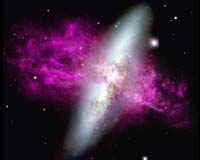
Astronomers Karl Gebhardt (The University of Texas at Austin) and Jens Thomas (Max Planck Institute for Extraterrestrial Physics) have used new computer modeling techniques to discover that the black hole at the heart of M87, one the largest nearby giant galaxies, is two to three times more massive than previously thought. Weighing in at 6.4 billion times the Sun's mass, it is the most ... more
|

| |||||||||||||||
| Previous Issues | Jun 08 | Jun 05 | Jun 04 | Jun 03 |
  Bonn, Germany (SPX) Jun 09, 2009
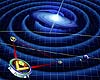
Space and time are no longer what they used to be - absolute dimensions of the universe without regard to anything external. That is how Isaac Newton described them in the seventeenth century. In 1915, Albert Einstein completed his general theory of relativity, which fundamentally changed our view of space and time. The general theory of relativity deals with one of the basic physical ... more   Bethesda MD (SPX) Jun 08, 2009
The spacefaring nations of the world are coming to the conclusion that the space debris issue has evolved from a minor nuisance to a full-blown imperative. Hundreds, if not thousands, of decision makers, engineers, managers, politicians and policy makers have focused their attention on how to deal with the fast-growing threat to operational satellites and future access to space. All that ... more   Hampton VA (SPX) Jun 09, 2009
The results of the second annual NASA Lunar Art Contest are out-of-this-world productions from high school and college students from around the globe. "Crater Core Sample," a painting by Zachary Madere of the Rocky Mountain College of Art and Design in Lakewood, Colo., was judged the best of more than 90 imaginative entries. The painting shows an astronaut holding an icy cylinder in a dark ... more   Pasadena CA (SPX) Jun 09, 2009
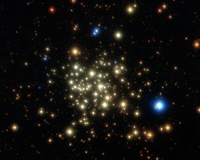
Gamma-ray bursts, with their ability to pierce through gas and dust to shine brightly across the universe, are revealing areas of intense star formation and stellar death where astronomers have been unable to look - the dusty corners of otherwise dust-free galaxies. The conclusion comes from a survey of "dark" gamma-ray bursts - bright in gamma- and X-ray emissions, but with little or no ... more |
. |
    |
. |



 |
. |
 Atlanta GA (UPI) Jun 4, 2009
 U.S. researchers are using a simulated data center to develop new methods to reduce the heat generated by large computer equipment. Georgia Institute of Technology scientists said about a third of the electricity consumed by large data centers doesn't power computer servers, but instead must be used to cool the servers, a demand that continues to increase as computer processing power grows. The ... more  Bethesda MD (SPX) Jun 03, 2009
Every entrepreneur pursuing the space debris opportunity seems to have the single answer to removing space debris. It is cost-effective, simple, quick, safe, reliable, user-friendly, non-polluting, non-interfering and almost ready to go. There is simply nothing like it and it is wonderful. Why doesn't the government grab it up and make the entrepreneur rich? In fact, why doesn't the ... more   Greenebelt MD (SPX) Jun 04, 2009
As the closest planet to the sun, Mercury is scorching hot, with daytime temperatures of more than 800 degrees Fahrenheit (approximately 450 degrees Celsius). It is also the smallest rocky planet, so its gravity is weak, only about 38 percent of Earth's. These conditions make it hard for the planet to hold on to its atmosphere, which is extremely thin, and invisible to the human eye. Howev ... more   Pasadena CA (SPX) Jun 04, 2009
Cloud chasers studying Saturn's moon Titan say its clouds form and move much like those on Earth, but in a much slower, more lingering fashion. Their forecast for Titan's early autumn - warm and wetter. Scientists with NASA's Cassini mission have monitored Titan's atmosphere for three-and-a-half years, between July 2004 and December 2007, and observed more than 200 clouds. They found ... more |
. |
      |
. |
   NASA launches Roman telescope on cosmic mapping mission
 DAMPE space telescope finds universal spectral feature that narrows field on cosmic ray origins
 Oxford Physicists Reach Fourth-Order Quantum Squeezing With Trapped Ion
 |
. |
|
| Previous Issues | Jun 08 | Jun 05 | Jun 04 | Jun 03 |
| The contents herein, unless otherwise known to be public domain, are Copyright 1995-2009 - SpaceDaily. AFP and UPI Wire Stories are copyright Agence France-Presse and United Press International. ESA Portal Reports are copyright European Space Agency. All NASA sourced material is public domain. Additional copyrights may apply in whole or part to other bona fide parties. Advertising does not imply endorsement, agreement or approval of any opinions, statements or information provided by SpaceDaily on any web page published or hosted by SpaceDaily. Privacy statement |