| June 05, 2009 |  |
a timely reality check |

 Atlanta GA (UPI) Jun 4, 2009 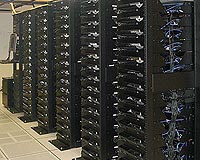 U.S. researchers are using a simulated data center to develop new methods to reduce the heat generated by large computer equipment. Georgia Institute of Technology scientists said about a third of the electricity consumed by large data centers doesn't power computer servers, but instead must be used to cool the servers, a demand that continues to increase as computer processing power grows. The ... read more
 Bethesda MD (SPX) Jun 03, 2009
Every entrepreneur pursuing the space debris opportunity seems to have the single answer to removing space debris. It is cost-effective, simple, quick, safe, reliable, user-friendly, non-polluting, non-interfering and almost ready to go. There is simply nothing like it and it is wonderful. Why doesn't the government grab it up and make the entrepreneur rich? In fact, why doesn't the ... more
|

| |||||||||||||||
| Previous Issues | Jun 04 | Jun 03 | Jun 02 | Jun 01 | May 31 |
  Greenebelt MD (SPX) Jun 04, 2009
As the closest planet to the sun, Mercury is scorching hot, with daytime temperatures of more than 800 degrees Fahrenheit (approximately 450 degrees Celsius). It is also the smallest rocky planet, so its gravity is weak, only about 38 percent of Earth's. These conditions make it hard for the planet to hold on to its atmosphere, which is extremely thin, and invisible to the human eye. Howev ... more   Pasadena CA (SPX) Jun 04, 2009
Cloud chasers studying Saturn's moon Titan say its clouds form and move much like those on Earth, but in a much slower, more lingering fashion. Their forecast for Titan's early autumn - warm and wetter. Scientists with NASA's Cassini mission have monitored Titan's atmosphere for three-and-a-half years, between July 2004 and December 2007, and observed more than 200 clouds. They found ... more   Moffett Field CA (SPX) Jun 02, 2009
Four hundred years ago, the Italian scientist Galileo revolutionized the science of astronomy by inventing the first telescope. People began to consider the possibility of discovering other worlds like Earth - fantastic worlds inhabited by weird and wonderful civilizations. As technology continued to improve our telescopic vision, we sadly learned that the other planets in our solar system ... more   London, UK (SPX) Jun 02, 2009
Large bombardments of meteorites approximately four billion years ago could have helped to make the early Earth and Mars more habitable for life by modifying their atmospheres, suggests the results of a paper published in the journal Geochimica et Cosmochima Acta. When a meteorite enters a planet's atmosphere, extreme heat causes some of the minerals and organic matter on its outer crust ... more |
. |
      |
. |



 |
. |
  Houston TX (SPX) May 29, 2009
Take one space shuttle, seven highly trained astronauts, tons of equipment, and one legendary orbiting telescope and you have the 5.3 million-mile odyssey that was the final servicing mission for NASA's Hubble Space Telescope. After months of training and a seven-month postponement, the STS-125 crew's mission got under way with an on-time launch into a brilliant-blue Florida sky. The May ... more  Moffett Field CA (SPX) May 29, 2009
Although Captain Kirk and crew could zip over to a planet at warp speed and teleport down to the surface to check if it was inhabited, current-day scientists will generally have to search for life from a distance. New research gives This handedness, or homochirality, is characteristic of life on Earth. The molecules that make proteins and DNA all have either a left-handed or right-handed ... more   Greenbelt MD (SPX) May 29, 2009
Using data from NASA's THEMIS mission, a team of University of Alberta researchers has pinpointed the impact epicenter of an earthbound space storm as it crashes into the atmosphere, and given an advance warning of its arrival. The team's study reveals that magnetic blast waves can be used to pinpoint and predict the location where space storms dissipate their massive amounts of energy. ... more  Greenbelt MD (SPX) May 29, 2009
The instrument is in pieces now, but its legacy lives on. Twenty-one years ago this month, the balloon-borne Gamma-Ray Imaging Spectrometer (GRIS) made the first of nine trips into the stratosphere. Those voyages, totaling 223 hours of flight time, helped astronomers catch a glimpse of the high-energy universe. Satellites such as the European Space Agency's (ESA) International Gamma-Ray ... more |
. |
     |
. |
   NASA launches Roman telescope on cosmic mapping mission
 DAMPE space telescope finds universal spectral feature that narrows field on cosmic ray origins
 Oxford Physicists Reach Fourth-Order Quantum Squeezing With Trapped Ion
 |
. |
|
| Previous Issues | Jun 04 | Jun 03 | Jun 02 | Jun 01 | May 31 |
| The contents herein, unless otherwise known to be public domain, are Copyright 1995-2009 - SpaceDaily. AFP and UPI Wire Stories are copyright Agence France-Presse and United Press International. ESA Portal Reports are copyright European Space Agency. All NASA sourced material is public domain. Additional copyrights may apply in whole or part to other bona fide parties. Advertising does not imply endorsement, agreement or approval of any opinions, statements or information provided by SpaceDaily on any web page published or hosted by SpaceDaily. Privacy statement |