| June 02, 2009 |  |
a timely reality check |

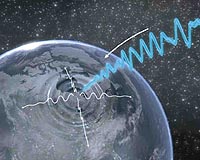
 Moffett Field CA (SPX) Jun 02, 2009  Four hundred years ago, the Italian scientist Galileo revolutionized the science of astronomy by inventing the first telescope. People began to consider the possibility of discovering other worlds like Earth - fantastic worlds inhabited by weird and wonderful civilizations. As technology continued to improve our telescopic vision, we sadly learned that the other planets in our solar system ... read more
  London, UK (SPX) Jun 02, 2009
Large bombardments of meteorites approximately four billion years ago could have helped to make the early Earth and Mars more habitable for life by modifying their atmospheres, suggests the results of a paper published in the journal Geochimica et Cosmochima Acta. When a meteorite enters a planet's atmosphere, extreme heat causes some of the minerals and organic matter on its outer crust ... more
|

| |||||||||||||||
| Previous Issues | Jun 01 | May 31 | May 29 | May 28 | May 27 |
  Warwick, UK (SPX) Jun 02, 2009
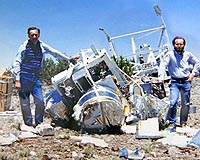
While humans are still struggling to get rid of unwanted carbon it appears that the heavens are really rather good at it. New research by astrophysicists at the University of Warwick has discovered that a mystery stellar explosion recorded in 2006 may have marked the unusual death of an equally unusually carbon-rich star. The strange object known as SCP 06F6 was first noted in 2006 by ... more  Berkeley CA (SPX) May 29, 2009
The chance discovery last month of a rare radio supernova - an exploding star seen only at radio wavelengths and undetected by optical or X-ray telescopes - underscores the promise of new, more sensitive radio surveys to find supernovas hidden by gas and dust. "This supernova is the nearest supernova in five years, yet is completely obscured in optical, ultraviolet and X-rays due to the ... more  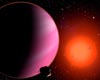 Pasadena CA (SPX) May 29, 2009
A long-proposed tool for hunting planets has netted its first catch - a Jupiter-like planet orbiting one of the smallest stars known. The technique, called astrometry, was first attempted 50 years ago to search for planets outside our solar system, called exoplanets. It involves measuring the precise motions of a star on the sky as an unseen planet tugs the star back and forth. But the ... more 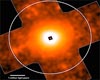 Berkeley CA (SPX) May 29, 2009
The joint Japan-U.S. Suzaku mission is providing new insight into how assemblages of thousands of galaxies pull themselves together. For the first time, Suzaku has detected X-ray-emitting gas at a cluster's outskirts, where a billion-year plunge to the center begins. "These Suzaku observations are exciting because we can finally see how these structures, the largest bound objects in the ... more |
. |
      |
. |



 |
. |
  Boston MA (SPX) May 29, 2009
NASA's Chandra X-ray Observatory has found a cosmic "ghost" lurking around a distant supermassive black hole. This is the first detection of such a high-energy apparition, and scientists think it is evidence of a huge eruption produced by the black hole. This discovery presents astronomers with a valuable opportunity to observe phenomena that occurred when the Universe was very young. The ... more  Bonn, Germany (SPX) May 28, 2009
An international team of radio astronomers have discovered the secret explosion of a massive star, a new supernova, in the nearby galaxy M82. Despite being the closest supernova discovered in the last five years, the explosion is exclusively detectable at radio wavelengths since the dense gas and dust surrounding the exploding star leave it invisible in other wavebands. Without the obscura ... more 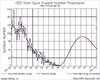 Boulder CO (SPX) May 28, 2009
An international panel of experts has released a new prediction for the next solar cycle, stating that Solar Cycle 24 will peak in May 2013 with a below-average number of sunspots. Led by the National Oceanic and Atmospheric Administration (NOAA) and sponsored by NASA, the panel includes a dozen members from nine different government and academic institutions. Their forecast sets the stage ... more  Paris, France (ESA) May 28, 2009
Using new data from ESA's XMM-Newton spaceborne observatory, astronomers have probed closer than ever to a supermassive black hole lying deep at the core of a distant active galaxy. The galaxy - known as 1H0707-495 - was observed during four 48-hr-long orbits of XMM-Newton around Earth, starting in January 2008. The black hole at its centre was thought to be partially obscured from view by ... more |
. |
       |
. |
   NASA launches Roman telescope on cosmic mapping mission
 DAMPE space telescope finds universal spectral feature that narrows field on cosmic ray origins
 Oxford Physicists Reach Fourth-Order Quantum Squeezing With Trapped Ion
 |
. |
|
| Previous Issues | Jun 01 | May 31 | May 29 | May 28 | May 27 |
| The contents herein, unless otherwise known to be public domain, are Copyright 1995-2009 - SpaceDaily. AFP and UPI Wire Stories are copyright Agence France-Presse and United Press International. ESA Portal Reports are copyright European Space Agency. All NASA sourced material is public domain. Additional copyrights may apply in whole or part to other bona fide parties. Advertising does not imply endorsement, agreement or approval of any opinions, statements or information provided by SpaceDaily on any web page published or hosted by SpaceDaily. Privacy statement |