| June 11, 2009 |  |
a timely reality check |

 Pasadena CA (SPX) Jun 11, 2009 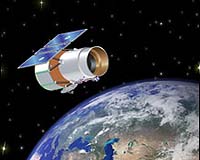 NASA's Wide-field Infrared Survey Explorer, or WISE, has been assembled and is undergoing final preparations for a planned Nov. 1 launch from Vandenberg Air Force Base, Calif. The mission will survey the entire sky at infrared wavelengths, creating a cosmic clearinghouse of hundreds of millions of objects - everything from the most luminous galaxies, to the nearest stars, to dark and ... read more
 Pasadena CA (SPX) Jun 11, 2009
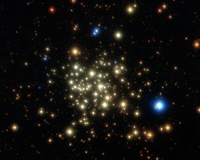
Astronomers have at last uncovered newborn stars at the frenzied center of our Milky Way galaxy. The discovery was made using the infrared vision of NASA's Spitzer Space Telescope. The heart of our spiral galaxy is cluttered with stars, dust, and gas, and at its very center, a supermassive black hole. Conditions there are harsh, with fierce stellar winds, powerful shock waves, and other ... more
|

| |||||||||||||||
| Previous Issues | Jun 10 | Jun 08 | Jun 05 | Jun 04 |
  Pasadena CA (SPX) Jun 11, 2009
Astronomers have presented high-resolution images of galaxies that were already old when the Universe was only 20 percent of its present age. The report was presented by Dr. Alan Stockton of the Institute for Astronomy, University of Hawaii at Manoa, in a press conference at the American Astronomical Society meeting in Pasadena, California, and includes work done with Dr. Gabriela Canalizo ... more  Pasadena CA (SPX) Jun 11, 2009
The red supergiant star Betelgeuse, the bright reddish star in the constellation Orion, has steadily shrunk over the past 15 years, according to University of California, Berkeley, researchers. Long-term monitoring by UC Berkeley�s Infrared Spatial Interferometer (ISI) on the top of Mt. Wilson in Southern California shows that Betelgeuse (bet� el juz), which is so big that in our solar system ... more   Washington (AFP) June 9, 2009
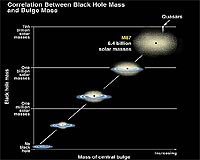
A pair of pioneering astronomers revealed Tuesday how they used a supercomputer to show that a nearby black hole is vastly more massive than scientists ever imagined. The black hole at the heart of the relatively close Messier 87 Galaxy (M87) weighs in at 6.4 billion times the mass of our Sun, according to US astrophysicist Karl Gebhardt and Germany's Jens Thomas, who say it's the largest ... more  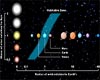 Seattle WA (SPX) Jun 11, 2009
As astronomers gaze toward nearby planetary systems in search of life, they are focusing their attention on each system's habitable zone, where heat radiated from the star is just right to keep a planet's water in liquid form. A number of planets have been discovered orbiting red dwarf stars, which make up about three-quarters of the stars close to our solar system. Potentially habitable ... more |
. |
     |
. |



 |
. |
  Bethesda MD (SPX) Jun 08, 2009
The spacefaring nations of the world are coming to the conclusion that the space debris issue has evolved from a minor nuisance to a full-blown imperative. Hundreds, if not thousands, of decision makers, engineers, managers, politicians and policy makers have focused their attention on how to deal with the fast-growing threat to operational satellites and future access to space. All that ... more   Hampton VA (SPX) Jun 09, 2009
The results of the second annual NASA Lunar Art Contest are out-of-this-world productions from high school and college students from around the globe. "Crater Core Sample," a painting by Zachary Madere of the Rocky Mountain College of Art and Design in Lakewood, Colo., was judged the best of more than 90 imaginative entries. The painting shows an astronaut holding an icy cylinder in a dark ... more  Pasadena CA (SPX) Jun 09, 2009
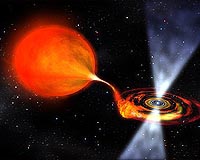
Gamma-ray bursts, with their ability to pierce through gas and dust to shine brightly across the universe, are revealing areas of intense star formation and stellar death where astronomers have been unable to look - the dusty corners of otherwise dust-free galaxies. The conclusion comes from a survey of "dark" gamma-ray bursts - bright in gamma- and X-ray emissions, but with little or no ... more 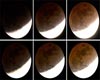 Troy NY (SPX) Jun 09, 2009
Lunar eclipses are well-documented throughout human history. The rare and breathtaking phenomena, which occur when the moon passes into the Earth's shadow and seemingly changes shape, color, or disappears from the night sky completely, caught the attention of poets, farmers, leaders, and scientists alike. Researchers at Rensselaer Polytechnic Institute have developed a new method for using ... more |
. |
    |
. |
   NASA launches Roman telescope on cosmic mapping mission
 DAMPE space telescope finds universal spectral feature that narrows field on cosmic ray origins
 Oxford Physicists Reach Fourth-Order Quantum Squeezing With Trapped Ion
 |
. |
|
| Previous Issues | Jun 10 | Jun 08 | Jun 05 | Jun 04 |
| The contents herein, unless otherwise known to be public domain, are Copyright 1995-2009 - SpaceDaily. AFP and UPI Wire Stories are copyright Agence France-Presse and United Press International. ESA Portal Reports are copyright European Space Agency. All NASA sourced material is public domain. Additional copyrights may apply in whole or part to other bona fide parties. Advertising does not imply endorsement, agreement or approval of any opinions, statements or information provided by SpaceDaily on any web page published or hosted by SpaceDaily. Privacy statement |