| June 22, 2009 |  |
a timely reality check |

 Paris, France (SPX) Jun 22, 2009  The next generation of instruments for ground-based telescopes took a leap forward with the development of a new ultra-fast camera that can take 1500 finely exposed images per second even when observing extremely faint objects. The first 240x240 pixel images with the world's fastest high precision faint light camera were obtained through a collaborative effort between ESO and three French ... read more
  Boulder CO (SPX) Jun 22, 2009
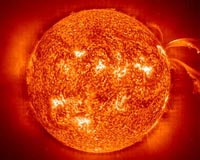
In a breakthrough that will help scientists unlock mysteries of the Sun and its impacts on Earth, an international team of scientists led by the National Center for Atmospheric Research (NCAR) has created the first-ever comprehensive computer model of sunspots. The resulting visuals capture both scientific detail and remarkable beauty. The high-resolution simulations of sunspot pairs open ... more
|

| |||||||||||||||
| Previous Issues | Jun 21 | Jun 20 | Jun 19 | Jun 18 | Jun 17 |
  San Antonio TX (SPX) Jun 22, 2009
Southwest Research Institute has received confirmation from NASA Headquarters that the Magnetospheric Multiscale (MMS) misson has been approved to begin its implementation phase. MMS will perform a definitive investigation of one of the most basic and important physical processes in the universe - magnetic reconnection. The mission is scheduled to launch in August 2014. Magnetic ... more   Moffett Field CA (SPX) Jun 22, 2009
Roughly a billion years from now, the ever-increasing radiation from the sun will have heated Earth into inhabitability; the carbon dioxide in the atmosphere that serves as food for plant life will disappear, pulled out by the weathering of rocks; the oceans will evaporate; and all living things will disappear. Or maybe not quite so soon, say researchers from the California Institute of ... more   Washington DC (SPX) Jun 19, 2009
On Aug. 22, 2008, NASA's Swift satellite reported multiple blasts of radiation from a rare object known as a soft gamma repeater, or SGR. Now, astronomers report an in-depth study of these eruptions using the European Space Agency's XMM-Newton and International Gamma-Ray Astrophysics Laboratory (INTEGRAL) satellites. The object, designated SGR 0501+4516, was the first of its type ... more   Chicago IL (SPX) Jun 19, 2009
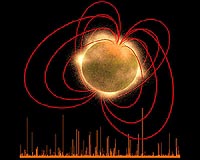
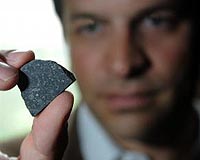
The interstellar stuff that became incorporated into the planets and life on Earth has younger cosmic roots than theories predict, according to the University of Chicago postdoctoral scholar Philipp Heck and his international team of colleagues. Heck and his colleagues examined 22 interstellar grains from the Murchison meteorite for their analysis. Dying sun-like stars flung the Murchison ... more |
. |
     |
. |



 |
. |
 Pasadena CA (SPX) Jun 18, 2009
NASA is scheduled to launch the Lunar Reconnaissance Orbiter, an unmanned mission to comprehensively map the entire moon,. One of the instruments aboard, the Diviner Lunar Radiometer Experiment, will make the first global survey of the temperature of the lunar surface while the orbiter circles some 50 kilometers (31 miles) above the moon. "The terrain on the far side of the moon is quite ... more  Boulder CO (SPX) Jun 18, 2009
Scientists from the National Solar Observatory (NSO) in Tucson, Arizona, have discovered that a solar jet stream deep inside the Sun is migrating slower than usual through the star's interior, giving rise to the current lack of sunspots and low solar activity, according to work being presented this week at the meeting of the Solar Physics Division of the American Astronomical Society (AAS/SPD). ... more  San Diego CA (SPX) Jun 17, 2009
An innovative sky survey has begun returning images that will be used to detect unprecedented numbers of powerful cosmic explosions - called supernovae - in distant galaxies, and variable brightness stars in our own Milky Way. The survey also may soon reveal new classes of astronomical objects. All of these discoveries will stem from the Palomar Transient Factory (PTF) survey, which combin ... more 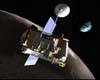 Washington (AFP) June 16, 2009
NASA embarks on a landmark mission of lunar exploration this week with the launch of probes to scout for water sources and landing sites, in a bid to lead humanity back on the first visit to the moon since 1972. The US space agency, with its eye on sending astronauts to Earth's natural satellite by 2020, is on course to blast off the dual LRO and LCROSS missions on Thursday atop an Atlas V ... more |
. |
     |
. |
   NASA launches Roman telescope on cosmic mapping mission
 DAMPE space telescope finds universal spectral feature that narrows field on cosmic ray origins
 Oxford Physicists Reach Fourth-Order Quantum Squeezing With Trapped Ion
 |
. |
|
| Previous Issues | Jun 21 | Jun 20 | Jun 19 | Jun 18 | Jun 17 |
| The contents herein, unless otherwise known to be public domain, are Copyright 1995-2009 - SpaceDaily. AFP and UPI Wire Stories are copyright Agence France-Presse and United Press International. ESA Portal Reports are copyright European Space Agency. All NASA sourced material is public domain. Additional copyrights may apply in whole or part to other bona fide parties. Advertising does not imply endorsement, agreement or approval of any opinions, statements or information provided by SpaceDaily on any web page published or hosted by SpaceDaily. Privacy statement |