|

  Atom Smasher To Jump Straight To Maximum Energy
Moscow, Russia (RIA Novosti) Feb 09, 2010 The Large Hadron Collider (LHC) will jump straight to its maximum energy without any medium-energy proton collisions, the European Organization for Nuclear Research (CERN) has said on its website. Experts, who gathered in Chamonix last week, revised the previous schedule according to which first physicists at the LHC were to switch to medium-energy beam collisions of 10 TeV this summer, following a short period of running at half-power of 7 TeV. "The most important decision we reached last w ... read more |
. |
 |
|
Free Space, Earth, Energy And Military Newsletters - Delivered Daily |
| . | . |
| .. |
 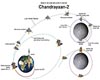 Bangalore, India (PTI) Feb 08, 2010
NASA and European Space Agency (ESA) want to be part of Chandrayaan-II, the next Indian mission to Moon, by sending their instruments, ISRO Chairman K Radhakrishnan said here today. Replying to a query whether NASA and ESA have sent proposals to ISRO to be part of Chandrayaan-II, expected in 2012 or 2013, by sending their instruments, Radhakrishnan told reporters, "They are all there actua ... more  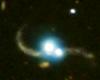 Pasadena CA (SPX) Feb 08, 2010
This composite image shows the effects of two galaxies caught in the act of merging. A Chandra X-ray Observatory image shows a pair of quasars in blue, located about 4.6 billion light years away, but separated on the sky by only about 70 thousand light years. These bright sources, collectively called SDSS J1254+0846, are powered by material falling onto supermassive black holes. An optical ... more   Monash, Australia (SPX) Feb 08, 2010
Monash University biochemists have found a critical piece in the evolutionary puzzle that explains how life on Earth evolved millions of centuries ago. The team, from the School of Biomedical Sciences, has described the process by which bacteria developed into more complex cells and found this crucial step happened much earlier in the evolutionary timeline than previously thought. Te ... more |
.. |
 Do Spirals Make Us So  Moon Exploration is Not Dead   Instant online solar energy quotes Solar Energy Solutions from ABC Solar |
.. |
|
|
Free Space, Earth, Energy And Military Newsletters - Delivered Daily |

|
. |
 Newborn Black Holes Boost Explosive Power of Supernovae
Huntsville AL (SPX) Feb 05, 2010 An international team of scientists, including two astronomers from NASA's Marshall Space Flight Center in Huntsville, Ala., have observed a supernova with peculiar radio emission. In the Jan. 28 issue of Nature, the team - led by Zsolt Paragi of the Joint Institute for Very Long Baseline Interferometry in Europe, or JIVE - reveals new details of these highly energetic explosions. Supernova SN 2007gr was discovered less than five days after its explosion at a distance of just 35 million light year ... read more |
 |
 |
 |
 |
 |
 |
 |
 |
 |
| The contents herein, unless otherwise known to be public domain, are Copyright 1995-2010 - SpaceDaily. AFP and UPI Wire Stories are copyright Agence France-Presse and United Press International. ESA Portal Reports are copyright European Space Agency. All NASA sourced material is public domain. Additional copyrights may apply in whole or part to other bona fide parties. Advertising does not imply endorsement, agreement or approval of any opinions, statements or information provided by SpaceDaily on any web page published or hosted by SpaceDaily. Privacy statement |
| Previous Issues | Feb 09 | Feb 08 | Feb 05 | Feb 04 | Feb 03 |