|

  Astronomers Say Alien Dust Is Nothing To Sneeze At
Los Angeles CA (SPX) Jan 07, 2010 Using the Gemini South telescope in Chile, astronomers at UCLA have found dusty evidence for the formation of young, rocky planets around a star some 500 light-years distant. But these potential extrasolar worlds are alien in an even more intriguing way: In the aftermath of collisions between planetary embryos around this star the researchers discovered that the dusty debris bears no resemblance to the planetary building blocks of our own Solar System. "Until now, warm dust found around other stars has been very similar in composition to asteroidal or cometary material in our Solar System," ... read more |
. |
 |
|
Free Space, Earth, Energy And Military Newsletters - Delivered Daily |
| .. |
  Garching, Germany (SPX) Jan 07, 2010
A team of astronomers led by Niv Drory of the Max Planck Institute for Extraterrestrial Physics, Garching, Germany), Kevin Bundy (University of California, Berkeley), and Alexie Leauthaud (Lawrence Berkeley National Lab and Berkeley Center for Cosmological Physics, Berkeley) used data from the COSMOS project to explore the connections between the growth of dark matter halos and the growth of ... more   Washington DC (SPX) Jan 07, 2010
Most searches for planets around other stars, also known as exoplanets, focus on Sun-like stars. Those searches have proven successful, turning up more than 400 alien worlds. However, Sun-like stars aren't the only potential homes for planets. New research by astronomers at the Harvard-Smithsonian Center for Astrophysics (CfA) and the National Optical Astronomy Observatory (NOAO) confirms ... more  Washington DC (SPX) Jan 07, 2010
ASTRON astronomers are part of an international team that is discovering the exotic stars known as "millisecond pulsars" at an astonishing rate. Whereas in the last thirty years only sixty millisecond pulsars have been identified in the disk of our Galaxy, seventeen new millisecond pulsars have been found in just the last three months by using large radio telescopes to target sources of high ... more |
.. |
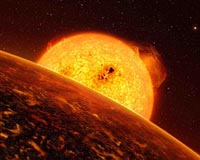
 Shining A Light On Missing Ordinary Matter 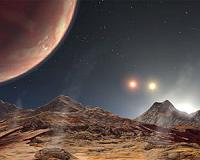 Earth-Like Planet Probably A Wasteland   Instant online solar energy quotes Solar Energy Solutions from ABC Solar |
.. |
|
|
Free Space, Earth, Energy And Military Newsletters - Delivered Daily |
| .. |
 Washington DC (SPX) Jan 06, 2010
In their quest to find solar systems analogous to ours, astronomers have determined how common our solar system is. They've concluded that about 15 percent of stars in our galaxy host systems of planets like our own, with several gas giant planets in the outer part of the solar system. "Now we know our place in the universe," said Ohio State University astronomer Scott Gaudi. "Solar system ... more  Washington DC (SPX) Jan 06, 2010
For almost two centuries, humans have looked up at a bright star called Epsilon Aurigae and watched with their own eyes as it seemed to disappear into the night sky, slowly fading before coming back to life again. Today, as another dimming of the system is underway, mysteries about the star persist. Though astronomers know that Epsilon Aurigae is eclipsed by a dark companion object every 27 year ... more  Washington DC (SPX) Jan 06, 2010
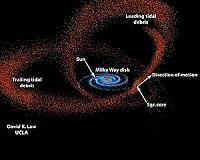
Astronomers have long known that the supermassive black hole at the center of the Milky Way Galaxy, known as Sagittarius A* (or Sgr A* for short), is a particularly poor eater. The fuel for this black hole comes from powerful winds blown off dozens of massive young stars that are concentrated nearby. These stars are located a relatively large distance away from Sgr A*, where the gravity of the b ... more |
.. |
 Faster-Than-Light Polarization Currents  The Mystery Of The Missing Spike In The Galaxy Arp 192  Hubble Images First Galaxies After The Big Bang |
.. |
|
|
Free Space, Earth, Energy And Military Newsletters - Delivered Daily |
 |
 |
 |
 |
 |
 |
 |
 |
 |
| The contents herein, unless otherwise known to be public domain, are Copyright 1995-2010 - SpaceDaily. AFP and UPI Wire Stories are copyright Agence France-Presse and United Press International. ESA Portal Reports are copyright European Space Agency. All NASA sourced material is public domain. Additional copyrights may apply in whole or part to other bona fide parties. Advertising does not imply endorsement, agreement or approval of any opinions, statements or information provided by SpaceDaily on any web page published or hosted by SpaceDaily. Privacy statement |
| Previous Issues | Jan 06 | Jan 05 | Jan 04 | Jan 01 | Dec 31 |