|
|

 Newcastle-Under-Lyme, England (UPI) Aug 27, 2009 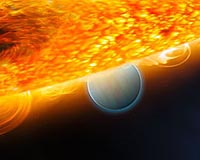 British scientists are trying to determine why a Jupiter-style planet orbiting close to its sun has not spiraled into the star and burned up. Wasp-18b is so close to the star Wasp-18 that it completes its orbit in less than an Earth-length day, astrophysicists at Keele University in Staffordshire say. In an article in Nature, they say standard astronomical theories hold the planet shoul ... read more
  Pasadena CA (SPX) Aug 28, 2009
A discovery about the moon made in the 1960s is helping researchers unlock secrets about Earth's ocean today. By applying a method of calculating gravity that was first developed for the moon to data from NASA's Gravity Recovery and Climate Experiment, known as Grace, JPL researchers have found a way to measure the pressure at the bottom of the ocean. Just as knowing atmospheric pressure a ... more
|

| |||||||||||||||
| Previous Issues | Aug 27 | Aug 26 | Aug 25 | Aug 24 | Aug 23 |
| . |
  Moffett Field CA (SPX) Aug 28, 2009
Cosmic rays pour down on Earth like a constant rain. We don't much notice these high-energy particles, but they may have played a role in the evolution of life on our planet. Some of the mass extinctions identified in the fossil record can be linked to an asteroid impact or increased volcanism, but many of the causes of those ancient die-offs are still open for debate. "There may have been ... more   Cambridge MA (SPX) Aug 28, 2009
Finding a comet can be a quick way to get some immortal fame - and a little spending money, as well. An annual award of several thousand dollars for discoveries of comets by amateur astronomers has just been announced for five individuals in five different countries. The Central Bureau for Astronomical Telegrams (CBAT) - operated by the Smithsonian Astrophysical Observatory (SAO) in Cambri ... more  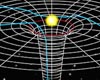 Washington DC (SPX) Aug 25, 2009
Does an exciting but controversial new model of quantum gravity reproduce Einstein's theory of general relativity? Scientists at Texas A and M University in the US explore this question in a paper appearing in Physical Review Letters and highlighted with a Viewpoint in the August 24th issue of Physics. "If it ain't broke, don't fix it," sums up fairly well how many scientists have viewed ... more |
. |
|
|
. |
  White Sands NM (SPX) Aug 20, 2009
Anyone who's vacationed in the mountains or lived on a farm knows that it's hard to get good internet access or a strong cell phone signal in a remote area. Communicating across great distances has always been a challenge. So when NASA engineers designed the Lunar Reconnaissance Orbiter (LRO), they knew it would need an extraordinary communications system. Over the next year, the LRO, NASA ... more  Sydney, Australia (SPX) Aug 20, 2009
For decades, microsatellites have been a boon to spaceflight. A small satellite can be built and launched fairly cheaply, sometimes hitching a ride for free aboard a large satellite launch. So far, microsatellites have not ventured very far into space. Could one go all the way to the Moon? Amateur groups have speculated on this possibility for years, but none have actually built a bird and ... more  Pasadena CA (JPL) Aug 20, 2009
How our solar system was formed has fascinated scientists and laymen alike for - well, for a really, really long time. New research may have answered a piece to the puzzle - how big were the first planetesimals? For those of you scoring at home," planetesimals" were the first solid objects in our newly minted solar system (also known as the protoplanetary disk). They began life as small ... more |
. |
| Previous Issues | Aug 27 | Aug 26 | Aug 25 | Aug 24 | Aug 23 |
| The contents herein, unless otherwise known to be public domain, are Copyright 1995-2009 - SpaceDaily. AFP and UPI Wire Stories are copyright Agence France-Presse and United Press International. ESA Portal Reports are copyright European Space Agency. All NASA sourced material is public domain. Additional copyrights may apply in whole or part to other bona fide parties. Advertising does not imply endorsement, agreement or approval of any opinions, statements or information provided by SpaceDaily on any web page published or hosted by SpaceDaily. Privacy statement |