|
|

 Sydeny, Australia (SPX) Aug 24, 2009  Whoever does it, and whenever it happens, spacecraft from Earth will be touching down on the Moon in the near future. Several nations have already announced plans for robot landers, and more could be announced in the years ahead. It's difficult to find safe ground to land on, as the crew of Apollo 11 can tell you. But one thing that also constrains landings is the need for a communications ... read more
  Bonn, Germany (SPX) Aug 25, 2009
"There's always a first time" - for the Iridium 33 communications satellite, the first collision between two satellites in space was, however, also the last time. On 10 February of this year its flight path crossed that of the retired Russian military satellite Kosmos 2251. Both satellites were completely destroyed and about 700 pieces of debris were distributed along their paths. Such ... more
|

| |||||||||||||||
| Previous Issues | Aug 24 | Aug 23 | Aug 21 | Aug 20 | Aug 19 |
| . |
  Cambridge MA (SPX) Aug 25, 2009
This fall a bright star will begin a puzzling transformation that only happens every 27 years. To help study this event, astronomers have launched a new citizen science project called "Citizen Sky". Epsilon Aurigae is a bright star that can be seen with the unaided eye even in bright urban areas of the Northern Hemisphere from fall to spring. This fall it is predicted to gradually lose ... more  Tempe AZ (SPX) Aug 25, 2009
Astronomers have been mining a mother lode of astronomical data from The University of Arizona's Catalina Sky Survey and finding more "optical transients" than they can characterize during the past 17 months. They have found more than 700 unique "optical transients," or objects that change brightness on time scales of minutes to years. They've also found 177 supernovae. That's more ... more   Corvallis OR (SPX) Aug 24, 2009
A team of researchers says it has largely put to rest a long debate on the underlying mechanism that has caused periodic ice ages on Earth for the past 2.5 million years - they are ultimately linked to slight shifts in solar radiation caused by predictable changes in Earth's rotation and axis. In a publication to be released Friday in the journal Science, researchers from Oregon State ... more |
. |
|
|
. |
 Sydney, Australia (SPX) Aug 20, 2009
For decades, microsatellites have been a boon to spaceflight. A small satellite can be built and launched fairly cheaply, sometimes hitching a ride for free aboard a large satellite launch. So far, microsatellites have not ventured very far into space. Could one go all the way to the Moon? Amateur groups have speculated on this possibility for years, but none have actually built a bird and ... more   Pasadena CA (JPL) Aug 20, 2009
How our solar system was formed has fascinated scientists and laymen alike for - well, for a really, really long time. New research may have answered a piece to the puzzle - how big were the first planetesimals? For those of you scoring at home," planetesimals" were the first solid objects in our newly minted solar system (also known as the protoplanetary disk). They began life as small ... more   Pasadena CA (JPL) Aug 20, 2009
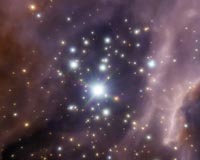
For decades, astronomers have gone about their business of studying the cosmos with the assumption that stars of certain sizes form in certain quantities. Like grocery stores selling melons alone, and blueberries in bags of dozens or more, the universe was thought to create stars in specific bundles. In other words, the proportion of small to big stars was thought to be fixed. For every st ... more |
. |
| Previous Issues | Aug 24 | Aug 23 | Aug 21 | Aug 20 | Aug 19 |
| The contents herein, unless otherwise known to be public domain, are Copyright 1995-2009 - SpaceDaily. AFP and UPI Wire Stories are copyright Agence France-Presse and United Press International. ESA Portal Reports are copyright European Space Agency. All NASA sourced material is public domain. Additional copyrights may apply in whole or part to other bona fide parties. Advertising does not imply endorsement, agreement or approval of any opinions, statements or information provided by SpaceDaily on any web page published or hosted by SpaceDaily. Privacy statement |