 |
 |
 |
 |
 |
 |
 |
 |
 |

 |
Probing The Milky Way History In Sloan Digital Sky Survey III
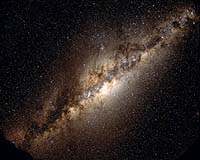
Charlottesville VA (SPX) Dec 16, 2008 Astronomy is a science of origins. "It's the ultimate exercise in archeology," said Steven Majewski, a University of Virginia professor of astronomy and lead scientist on a new project to survey more than 100,000 Milky Way red giant stars - bright, bloated stars in a late stage of their evolution. The project, the Apache Point Observatory Galactic Evolution Experiment, or APOGEE, is one of four experiments of the new Sloan Digital Sky Survey III, using the astronomical facilities at Apache Point Observatory in New Mexico. APOGEE was selected as a Sloan-III project through a competitive proposal led by U.Va. astronomers. "The spectra of red giant stars contain the chemical and dynamical fingerprints needed to understand the assembly of our Milky Way galaxy," Majewski said. "Our home galaxy, the Milky Way, is a typical spiral galaxy and an important laboratory for gaining a detailed understanding of galaxies in general. "APOGEE will be the first truly comprehensive study of the chemistry of Milky Way stars. With APOGEE, we will gain enormous insight to the processes that make stars and that drive the formation and evolution of galaxies." Though red giants are extremely bright, those in distant parts of the Milky Way - like the center of our galaxy 25,000 light-years away - are largely obscured by massive clouds of interstellar dust scattered across the vastness of space. Because of these dust clouds, only a relatively small fraction of stars in the Milky Way can be observed in visible light. Much more of our galaxy comes into view when astronomers use instruments that allow observations in the infrared. Infrared cameras and spectrographs observe light at wavelengths longer than visible light, allowing astronomers to peer through interstellar dust to detect the chemical makeup of stars and to calculate their motions and distances. U. Va. astronomer Michael Skrutskie, an expert in the design of infrared cameras and spectrographs, is leading a U.Va. team in the design and construction of a unique instrument that will provide unprecedented information about the dynamics and chemical constitution of Milky Way stars. His highly specialized spectrograph will be connected to a 2.5-meter telescope at Apache Point, allowing for detailed observation of 300 stars simultaneously. Majewski and other astronomers participating in the APOGEE project will observe thousands of red giants per clear night over the course of three years with the instrument. "Currently, being able to observe 10 red giants per night at APOGEE's level of detail would be considered good," Majewski said. U. Va. is trading expertise � and the new spectrograph � for membership in the Sloan Digital Sky Survey III project, which is operated by the Astronomical Research Consortium, a group of universities conducting research at Apache Point Observatory. The $36 million Sloan-III project is supported by the Sloan Foundation, federal agencies such as the National Science Foundation and Department of Energy, and by member institutions. Skrutskie previously was principal investigator for the Two-Micron All Sky Survey, a major project that surveyed the entire sky in the infrared, providing a database of more than a billion stars and galaxies for astronomers to peruse. That survey is helping Majewski to identify the 100,000 red giants the U.Va. team will investigate in much greater detail using Skrutskie's new spectrograph. "APOGEE will inevitably create a lasting legacy of discovery," said U.Va. astronomy department chairman John Hawley. Other projects of the Sloan-III survey, carried out by teams of astronomers from an international collaboration of universities and research organizations, will attempt to detect the effects of dark energy; map the stars of the Milky Way halo, and search for evidence of planets orbiting a sampling of 11,000 nearby stars. The preceding Sloan-I and Sloan-II surveys have been widely regarded as the highest-impact astronomical projects of their time. Related Links University of Virginia Astronomy News from Skynightly.com
 Omega Centauri - Glittering Giant Of The Southern Skies
 Paris, France (SPX) Dec 03, 2008
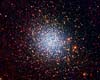
Omega Centauri is one of the finest jewels of the southern hemisphere night sky, as ESO's latest stunning image beautifully illustrates. Containing millions of stars, this globular cluster is located roughly 17 000 light-years from Earth in the constellation of Centaurus. |
|
|

| The content herein, unless otherwise known to be public domain, are Copyright Space.TV Corporation. AFP and UPI Wire Stories are copyright Agence France-Presse and United Press International. ESA Portal Reports are copyright European Space Agency. All NASA sourced material is public domain. Additional copyrights may apply in whole or part to other bona fide parties. Advertising does not imply endorsement, agreement or approval of any opinions, statements or information provided by Space.TV Corp on any Web page published or hosted by Space.TV Corp. Privacy Statement |