| July 09, 2009 |  |
a timely reality check |

 Paris, France (SPX) Jul 09, 2009 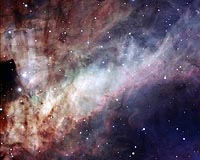 The Omega Nebula, sometimes called the Swan Nebula, is a dazzling stellar nursery located about 5500 light-years away towards the constellation of Sagittarius (the Archer). An active star-forming region of gas and dust about 15 light-years across, the nebula has recently spawned a cluster of massive, hot stars. The intense light and strong winds from these hulking infants have carved ... read more
  Bethesda MD (SPX) Jul 09, 2009
Launchspace has been studying the space debris issue with an eye toward private sector participation. After all, we cannot expect world governments to willingly contribute to debris reduction until they have to. No agency of a space-faring nation will want to commit huge amounts of funding to the removal of space objects. These agencies are only interested in placing satellites in orbit in ... more
|

| |||||||||||||||
| Previous Issues | Jul 08 | Jul 07 | Jul 06 | Jul 05 | Jul 03 |
  San Diego CA (SPX) Jul 09, 2009
A team of astrophysicists has solved a mystery that led some scientists to speculate that the distribution of certain gamma rays in our Milky Way galaxy was evidence of a form of undetectable "dark matter" believed to make up much of the mass of the universe. In two separate scientific papers, the most recent of which appears in the July 10 issue of the journal Physical Review Letters, the ... more   Paris (AFP) July 8, 2009
A rare photographic collection showing in Paris this week traces the entire 13-year US space odyssey that put Neil Armstrong on the moon and features original snapshots of the lunar landing. At the Palais de Tokyo arthouse until September 20, the exhibition features original prints of snapshots taken for NASA first by robots, then by astronauts, that were collected over a decade by two young ... more  Stanford CA (SPX) Jul 09, 2009
Astronomers now have a better understanding of how stars progress, thanks to NASA's Fermi Space Telescope that has detected numerous pulsars by the gamma rays they emit. When a massive star explodes, it leaves behind a compact core called a pulsar. Like a spinning firecracker spitting out sparks, these magnetized cores emit high-energy light particles called gamma rays as they rapidly ... more   Moffett Field CA (SPX) Jul 09, 2009
Two University of Hawai'i at Manoa astronomers have found a binary star-disk system in which each star is surrounded by the kind of dust disk that is frequently the precursor of a planetary system. Doctoral student Rita Mann and Dr. Jonathan Williams used the Submillimeter Array on Mauna Kea, Hawaii to make the observations. A binary star system consists of two stars bound together by ... more |
. |
      |
. |



 |
. |
 San Marcos TX (SPX) Jul 07, 2009
Famed Norwegian artist Edvard Munch (1863-1944) has long been a favorite of Texas State University-San Marcos faculty members Don Olson and Russell Doescher. In 2003, the physics department researchers connected the blood-red sky of Munch's anguished masterpiece "The Scream" to the 1883 eruption of Krakatoa on the other side of the globe. They turned their attention to Munch's beloved ... more  Amado AZ (SPX) Jul 06, 2009
An international collaboration of 390 scientists reports the discovery of an outburst of very-high-energy (VHE) gamma radiation from the giant radio galaxy Messier 87 (M87), accompanied by a strong rise of the radio flux measured from the direct vicinity of its supermassive black hole. The combined results give first experimental evidence that particles are accelerated to extremely high ... more  Paris, France (ESA) Jul 06, 2009
Last night, the detectors of Planck's High Frequency Instrument reached their amazingly low operational temperature of -273.05 degrees C, making them the coldest known objects in space. The spacecraft has also just entered its final orbit around the second Lagrange point of the Sun-Earth system, L2. Planck is equipped with a passive cooling system that brings its temperature down to about ... more  Manoa HI (SPX) Jul 06, 2009
Two University of Hawaii at Manoa astronomers have found a binary star-disk system in which each star is surrounded by the kind of dust disk that is frequently the precursor of a planetary system. Doctoral student Rita Mann and Dr. Jonathan Williams used the Submillimeter Array on Mauna Kea, Hawaii to make the observations. A binary star system consists of two stars bound together by ... more |
. |
     |
. |
   NASA launches Roman telescope on cosmic mapping mission
 DAMPE space telescope finds universal spectral feature that narrows field on cosmic ray origins
 Oxford Physicists Reach Fourth-Order Quantum Squeezing With Trapped Ion
 |
. |
|
| Previous Issues | Jul 08 | Jul 07 | Jul 06 | Jul 05 | Jul 03 |
| The contents herein, unless otherwise known to be public domain, are Copyright 1995-2009 - SpaceDaily. AFP and UPI Wire Stories are copyright Agence France-Presse and United Press International. ESA Portal Reports are copyright European Space Agency. All NASA sourced material is public domain. Additional copyrights may apply in whole or part to other bona fide parties. Advertising does not imply endorsement, agreement or approval of any opinions, statements or information provided by SpaceDaily on any web page published or hosted by SpaceDaily. Privacy statement |