 |
 |
 |
 |
 |
 |
 |
 |
 |

 |
Planets Align For The Fourth Of July
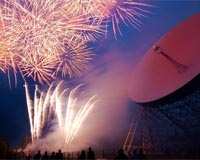
Huntsville AL (SPX) Jul 02, 2008 On 4th of July weekend, NASA forecasts lights in the sky. No, not those lights. Look beyond the fireworks. Almost halfway up the western sky, just above the twilight glow of sunset, a trio of worlds is gathering: Saturn, Mars and the crescent Moon. The show gets going on Friday, July 4th. Red Mars and ringed Saturn converge just to the left of the bright star Regulus. The three lights make a pretty 1st-magnitude line in the heavens: sky map. But that is just the beginning. On Saturday, July 5th, with weekend fireworks at fever pitch, a lovely crescent Moon joins the show. Saturn, Mars, and the Moon trace an even brighter line than the night before: sky map. Scan a small telescope along the line. You'll see Saturn's rings, the little red disk of Mars, a grand sweep of lunar mountains and craters, and just maybe-flash!-a manmade incendiary. How often do you see fireworks through a telescope? This is, however, more than just a flashy gathering of planets-it is also a gathering of spaceships and robots. Each of the three worlds is orbited or inhabited by probes from Earth. Saturn has the Cassini spacecraft, studying the gas giant's storms, moons and rings. The Moon has two probes in orbit: Kaguya from Japan and Chang'e-1 from China. The pair, operating independently, are mapping the Moon and scanning for resources in advance of future human landings. NASA's Lunar Reconnaissance Orbiter will join them later this year. Mars has more probes than the others combined. Three active satellites orbit the red planet: Europe's Mars Express and NASA's Mars Odyssey and Mars Reconnaissance Orbiter. The three not only study Mars with their own instruments, but also form a satellite network in support of NASA's Mars rovers Spirit and Opportunity and Mars lander Phoenix. None of these mechanical specks are visible in a backyard telescope, but they are there, heralds of a growing human presence in the solar system. Tell that to your buddy at the fireworks show! During the short night of July 5th, the Moon glides past Mars and Saturn so that nightfall on Sunday, July 6th, brings a different arrangement-a scalene triangle. The triad is easy to find in the hours after sunset. Look west and let the Moon be your guide: sky map. In the nights that follow, the Moon exits stage left, leaving the others behind. Don't stop watching, though. Saturn and Mars are converging for their closest encounter of the next 14 years. After nightfall on Thursday, July 10th, the two planets will be just � of a degree apart, snug enough to fit behind the tip of your pinky finger held at arm's length: sky map. Now that's spectacular-no fireworks required. Related Links Astronomy News from Skynightly.com
 Astronomers Re-Date Caesar's Invasion Of Britain
 San Marcos TX (SPX) Jul 01, 2008
Researchers from Texas State University have revised the date when Julius Caesar invaded Britain in 55 BC, a transformational event in world history. Despite what most history books state, Caesar could not have landed on August 26-27. |
|
|

| The content herein, unless otherwise known to be public domain, are Copyright Space.TV Corporation. AFP and UPI Wire Stories are copyright Agence France-Presse and United Press International. ESA Portal Reports are copyright European Space Agency. All NASA sourced material is public domain. Additional copyrights may apply in whole or part to other bona fide parties. Advertising does not imply endorsement, agreement or approval of any opinions, statements or information provided by Space.TV Corp on any Web page published or hosted by Space.TV Corp. Privacy Statement |